
AEA6 COOKING AND PREPARATION
TASK 1 - LISTENING 
FOOD PRESERVATION
a. Listen to a chef talking about different cold preservation techniques and decide if these statements are true or false.
a. Freezing completely destroys 30-70% of bacteria. T/F
b. Freezing at sea makes crustaceans lose taste and nutritional value. T/F
c. Deep freezing is slow freezing to a low temperature. T/F
d. Peas and sweetcorn may have a superior flavour when individually quick-frozen. T/F
e. IQF and cryogenic freezing both have a low environmental impact. T/F
f. Fruit and vegetables remain fresh for several weeks when refrigerated. T/F
b. Listen again and fill in the missing information in the numbered spaces.
Cold preservation techniques
Freezing deteriorates the original properties and nutritional value of (1) _____________________. Deep
freezing cools food to at least (2) _____________________, within (3) _____________________.
Individually quick-frozen (IQF) freezes individual pieces of fruit and vegetables at (4) _____________________
in only (5) _____________________ with liquid nitrogen.
Cryogenic freezing uses (6) _____________________. This works weel for fish, meat and vegetables as
well as (7) _____________________.
C. Complete the following text with the correct word from the box. There are 2 extra words.
Food preservation is an ancient skill. The __________ liked drying fruit and in the Middle _____________ people built 'still houses' to dry fruit, vegetables and herbs in areas
that did not have enough ______________, building fires which also smoked and flavoured their food. The ________________ were using salt, spices and smoking to preserve
food as far back as 1000BC and the ancient _______________ stored their potatoes and other foods at high altitude ____________ they lived in the Andes Mountains. The food ___________
as the reduced atmospheric pressure made the water ______________ more quickly than it would have at sea level.
|
Ages where froze became Americans Romans Chinese sun Incas disappear |
TASK 2 - READING 
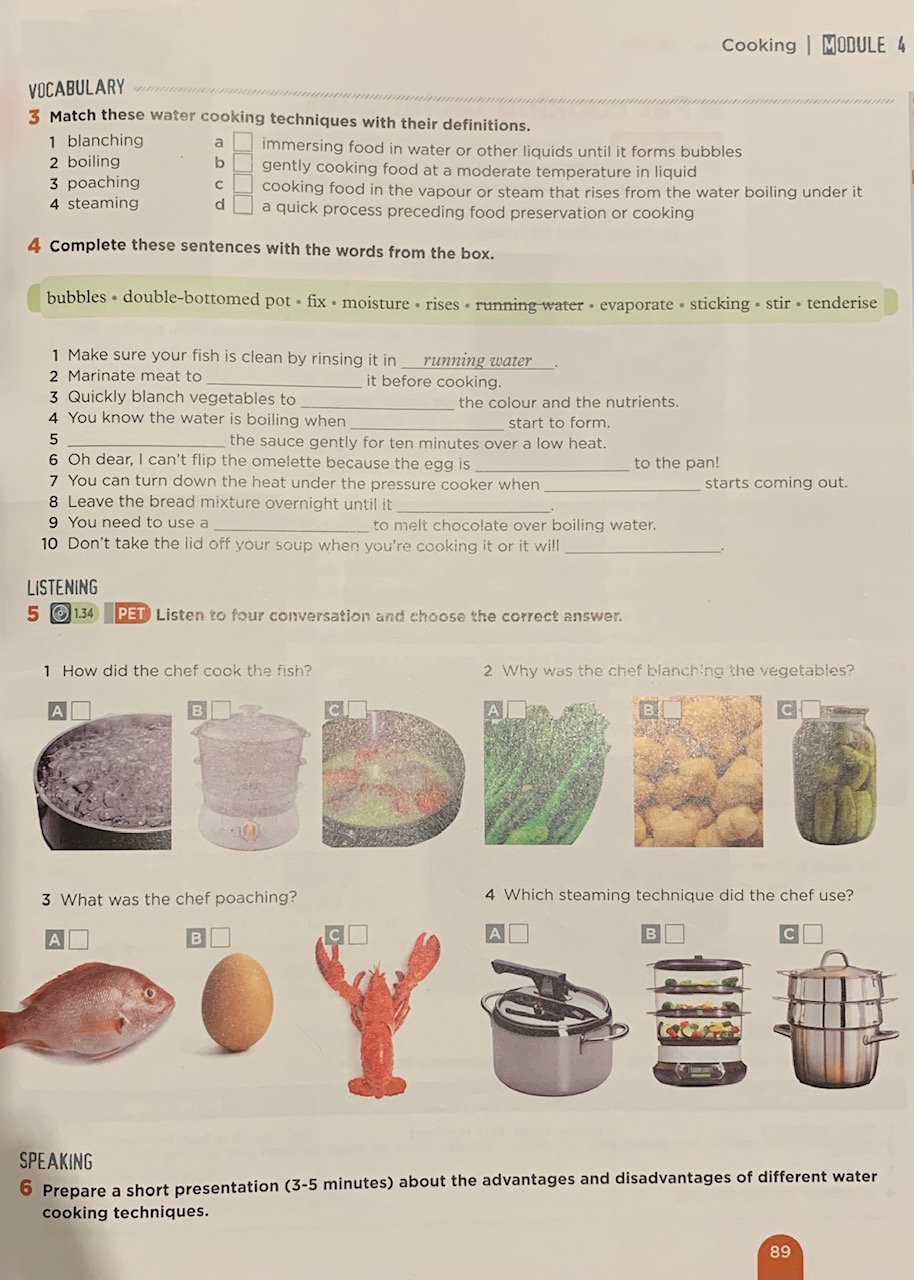
COOKING TECHNIQUES
Read the text about water cooking techniques and do all the exercises. Here's the audio for the listening exercise.

TASK 3 - GET REAL! 
A. Did you know this tool? Vocabulari de Restaurants, del Departament de Comerç, Consum i Turisme, de la Generalitat de Catalunya.
In pairs, let's see who are the fastest to get the correct translation of these 10 dishes? Ready? Steady? Go!
1. llegums =
2. Torrades amb allioli de codony =
3. Ajoblanco =
4. Paella a la marinera =
5. Coca de pebrot i llonganissa =
6. Xató =
7. Calçots =
8. Calamars a la romana =
9. Braç de gitano de nata =
10. Sardines a la brasa =
B. Let's translate next menus for La Sitja.
Tools:
- Linguee (dictionary and examples where the word has been used and published)
- DeepL (translator)
|
05/05 – 23/05 Menú Tonyina |
- Tuna Tàrtar - Brou Dashi amb ravioli de tonyina - Ou, patata, tonyina i tòfona - Tataki de tonyina i monogràfic de verds - Fricandó de tonyina/ventresca amb bolets i verduretes
|
-Tàrtar de maduixa - Dau de “red velvet” amb tàrtar de gerds - Pastís de formatge amb fruits vermells |
TASK 4 - RA3+RA5 (SPEAKING + PROFESSIONAL SKILLS) ASSESSING MARK 

FOOD PRESERVATION AND COOKING TECHNIQUES
NSTRUCTIONS:
With this project you're going to become experts on your category and are going to teach your classmates and your teacher too.
It's fundamental that you speak with a clear voice and poise, for your mates to understand you properly.
Classmates are going to take notes for next test.
1. Create a digital presentation
2. Give it a title
3. Share it with teacher
4. Start with a presentation slide introducing your general topic and explaining what it consists of. Make use of images and key words only.
5. Include a slide for every technique but only use images and key words (penalization for using text in the digital document):
- technique
- explanation
- how it affects food (positive and negative effects)
- food you can apply this technique to
- whatever other interesting information you come across
This will be your RA3+ RA5 (speaking) mark for this unit, so do your best!
TASK 5 - GRAMMAR 
RELATIVE SENTECES
1. Review relative clauses.
2. Combine the sentences in this exercise with a suitable relative pronoun.
3. Another exercise on relative clauses.
4. Non-defining relative clauses exercise
CLAUSES OF PURPOSE
1. There's a presentation outside this document.
2. Join the sentences using the words given.
-
He went to Bristol. He wanted to visit his grandparents. (in order to)
-
She worked late. She wanted to finish the article on time. (so as to)
-
I went to the supermarket. I wanted to get some orange juice. (to)
-
He spoke loudly. He wanted everyone to hear him. (in order that)
-
He’s been training hard. He wants to win the race. (so as to)
-
Give them your address. They can send you the contract. (so that)
-
She wanted to get good marks. She didn’t want her parents to be disappointed. (so that)
-
I’ll leave him a message. He won’t wonder where I am. (so)
3. Join the sentences using in order (not) to/so as (not) to or in order that/so that.
a. They lit a fire. They wanted to keep warm.
b. I bought some more popcorn. We wanted to have enough for the party.
c. I’m going to the bank. I want to ask for a loan.
d. Myra wrote down Valerie’s address. She didn’t want to forget it.
e. We turned down the music. We didn’t want the neighbours to start complaining.
f. Close the window. I don’t want the cat to go out.
g. Frances took off his shoes. He didn’t want to make any noise.